Top 10 Must-Play Idle Clicker Games
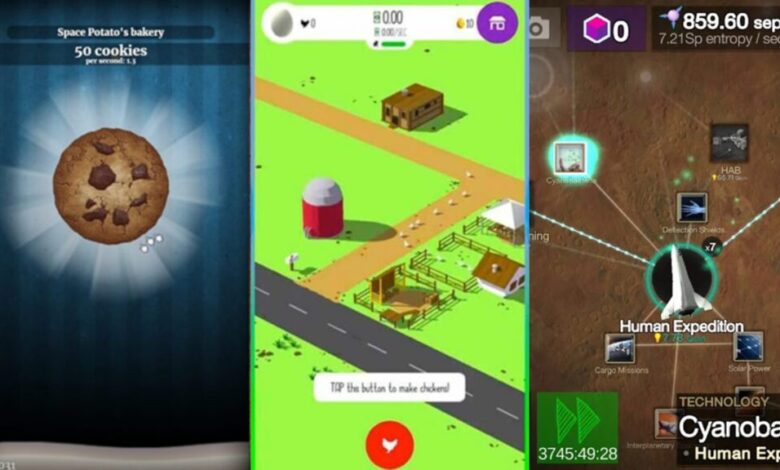
Idle clicker games may seem simple at first glance. A few clicks, a number increasing, and that’s it. However, the most impactful ones in the genre have evolved far beyond this basic premise. These games introduce layers of complexity, where automation takes over and numbers start to grow exponentially. At some point, the experience shifts from mere clicking to strategic decision-making or even programming. As a result, many of these games no longer fit neatly into the idle genre, redefining what players expect from this type of gameplay.
Here are 10 idle games that have significantly influenced the genre:
10. Clickpocalypse 2
Clickpocalypse 2 is an automated RPG where a party explores dungeons without direct player control. Players focus on managing upgrades, loot, and progression while the game runs itself. It was one of the earliest examples of a game where the player steps back entirely, guiding progression through careful management rather than active participation.
9. Egg Inc.
Egg Inc. is a farming-based idle game centered around managing a large-scale egg production business. Players hatch chickens, upgrade farms, and automate processes to increase output. The game emphasizes smooth pacing and presentation, proving that even with minimal new mechanics, a well-crafted loop can keep players engaged.
8. AdVenture Capitalist
AdVenture Capitalist starts as a simple business simulation, where players build an empire from a lemonade stand. While it initially resembles Monopoly with features like investing in ventures, the game diverges by introducing managers who automate production. This shift helped popularize the “tycoon idle” format, making it accessible to a broader audience.
7. Idle Miner Tycoon
In Idle Miner Tycoon, players manage a growing mining operation. Workers extract resources, which are transported and processed for profit. Managers automate different parts of the workflow, creating a system where players must balance multiple stages of the process.
6. Cell to Singularity
Cell to Singularity is a game that focuses on evolution. Generating entropy and unlocking scientific milestones keeps the progression going. The game expands beyond Earth into space and future technologies, taking the usual number climb and tying it to a structured, science-driven timeline.
5. Melvor Idle
Melvor Idle draws inspiration from classic RPGs and transforms them into a menu-driven idle experience. Players train skills, gather resources, and complete combat tasks with minimal interaction. It demonstrates that a full RPG grind can be achieved without real-time control.


4. Idle Champions of the Forgotten Realms
This game combines Dungeons and Dragons with idle clicker mechanics. Players build formations of heroes that automatically battle enemies and generate resources. Placement and setup matter just as much as raw upgrades, blending idle progression with team-based strategy.
3. Clicker Heroes
Clicker Heroes merges idle mechanics with RPG combat. Players upgrade heroes with gold earned from defeating enemies. Initially reliant on manual clicks, the gameplay transitions to automation as heroes level up. It set the standard for scaling heroes, damage curves, and progression walls.
2. The Farmer Was Replaced
This game looks more like a programming challenge than an idle clicker. Players write scripts to control farming drones and optimize production systems. Instead of passive automation, efficiency depends on how well the systems are designed, turning the entire loop into a problem of logic rather than time.
1. Cookie Clicker
Cookie Clicker brought idle clickers into the mainstream. The game revolves around generating cookies through clicks and automation. It also introduced prestige resets, which reward long-term play with permanent boosts. This reset loop is why most idle games don’t just end—they restart stronger.
The “idle” genre is evolving, incorporating elements from RPGs, strategy, and even programming. As it continues to develop, simple click-and-wait loops are becoming less relevant. What’s coming next leans toward deeper systems, smarter automation, and progression that feels genuinely earned.