Why Your iPhone Battery Icon Is Yellow – and How to Fix It

A modern iPhone is great for many things, especially when it comes to notifying you about certain issues. When you look at an iPhone’s display, you may see a variety of icons that provide information about your device. However, some of these icons, like the half-moon symbol, are only useful if you actually understand what they’re trying to convey.
So why is your battery icon yellow? If you’re not familiar, the battery icon on an iPhone will turn yellow when the device is in Low Power Mode. It can be a useful feature that works well with your device’s battery, but it also comes at the cost of reducing some of your iPhone’s features and hardware capabilities. Fortunately, this mode is only enabled in certain situations, and Apple provides users with multiple ways to disable it. Naturally, should you find that you like it, there are also ways to ensure that it never turns off.
Considering battery life can be rather valuable, users should be aware of the ins and outs of Low Power Mode to ensure they’re getting the most out of their device. When your device is in this mode, it will behave differently. This includes disabling 5G on most devices (excluding the iPhone 12 and 13 lineups when downloading large files or streaming video) and reducing display brightness, among other areas where certain features are reduced.
Understanding Low Power Mode
Low Power Mode is a built-in feature designed to help extend your iPhone’s battery life. Introduced back in 2015 with iOS 9, it allows your device to conserve energy by limiting background activity and adjusting performance settings. While this can be beneficial in situations where you need your iPhone to last longer without charging, it also means that some of the more power-hungry features may be disabled or restricted.
Some of the key changes that occur when Low Power Mode is active include:
- Disabling 5G connectivity on most models, except for the iPhone 12 and 13 series when performing tasks like downloading large files or streaming video.
- Reducing display brightness to save power.
- Limiting background app refresh, which means apps won’t update as frequently in the background.
- Disabling visual effects such as animations and transitions.
- On devices with ProMotion displays, lowering the refresh rate to 60Hz instead of the usual 120Hz.
These adjustments can make a noticeable difference, especially during resource-intensive tasks, as the GPU and CPU may be throttled to conserve energy.
How to Disable Low Power Mode
If you’re curious why your battery icon is yellow on your iPhone, it’s because the device is in Low Power Mode, and it may actually be a feature you want to use more often. However, if you don’t like it, there are several ways to disable Low Power Mode.
Here are the steps:


- Open Settings on your iPhone.
- Choose Battery.
- Select Power Mode.
- Tap Low Power Mode to enable it or disable it.
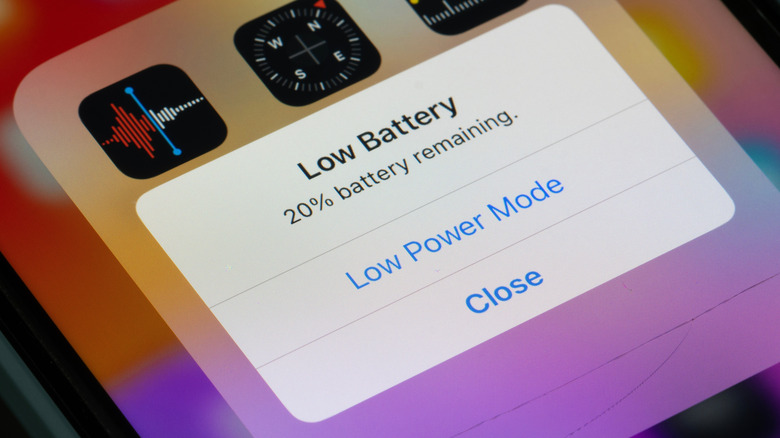
Those using an iPhone 14 or earlier may need to navigate to Settings, choose Battery, and then enable or disable Low Power Mode. You can also ask Siri to turn Low Power Mode on or off, or disable it in Control Center through the Battery icon. Note that devices with Adaptive Power enabled will automatically enable the feature when the device drops below 20%.
What Happens When You Enable Low Power Mode?
When Low Power Mode is enabled, your iPhone will automatically adjust its performance and functionality to conserve battery life. Some of the changes include:
- Disabling certain features, including visual effects and background app refresh.
- Limiting refresh rates on devices with ProMotion displays to 60Hz.
- Throttling the GPU and CPU during resource-intensive tasks.
However, Low Power Mode automatically disables when a device charges to 80% or higher. Of course, you can always charge the device with the appropriate cable to ensure Low Power Mode properly goes away.