
Poco C81 Pro review: Affordable HP with wide screen and long battery life

The increasing price of smartphones makes entry-level devices attract attention again, especially in the price range of Rp. 1 million. In this segment, users usually look for devices that can be used for basic needs, such as calling, sending messages, or surfing the internet, but remain stable in daily use.
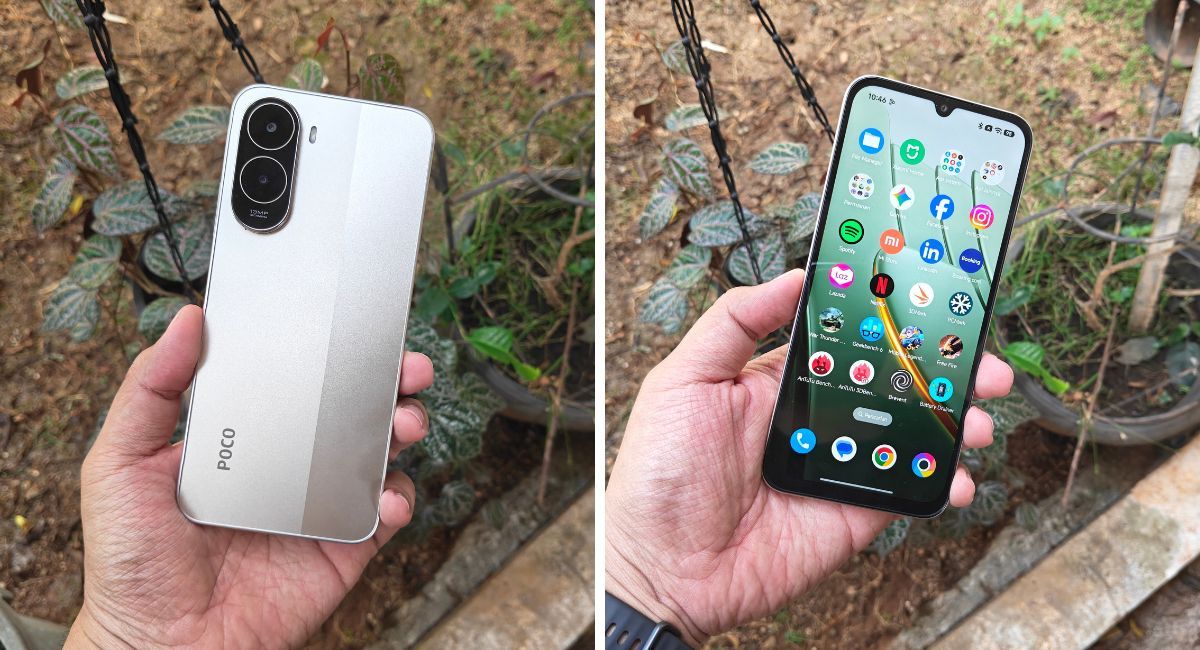
In the midst of this situation, the Poco C81 Pro is trying to enter the market. Xiaomi Indonesia includes the Poco C81 Pro as part of the POCO C Series line with prices ranging from around Rp. 1.6 million to Rp. 1.7 million, depending on the variant and the applicable promo.
The official variant available on the specification page is 4 GB + 64 GB and 4 GB + 128 GB, equipped with LPDDR4X RAM and UFS 2.2 storage. With this price, the Poco C81 Pro answers the needs of consumers of this class for a reliable smartphone, with a large screen, long battery life, and a long service life.
design and screen
By design, the Poco C81 Pro looks simple with a combination of windshield and a plastic body, which is reasonable for the price class of IDR 1 million. It weighs about 208 grams with a thickness of 8.2 mm, feels big because of the 6.9-inch screen and a 6,000 mAh battery. This size may be less convenient for users who like compact HP, but are suitable for content consumption.
The back carries a dual tone design with a choice of black, gold, and green colors. The Green variant looks the most striking, while the other two are more neutral. The screen is the main attraction. The Poco C81 Pro uses a 6.9-inch IPS LCD panel with a refresh rate of 120Hz, which makes the animation and scrolling feel smoother than the 60Hz screen.

However, the resolution is still HD + (1600 x 720 pixels), so the sharpness is not as high as the Full HD + screen. The brightness of the screen is in the range of 650 nits and can reach 800 nits, enough for indoor use, but less optimal in the hot sun.

In addition, because it is still the IPS LCD, the contrast and color are not as lively as AMOLED—the black looks gray and the display is less deep. Even so, the screen remains responsive and large in size, making it convenient for daily use such as watching and browsing.
Performance
POCO C81 Pro uses Unisoc T7250 based 12 nm fabrication with octa-core CPU (2x Cortex-A75 1.8 GHz + 6x Cortex-A55 1.6 GHz) and GPU Mali-G57. This device comes with 4 GB of RAM which can be expanded virtually, as well as a choice of storage of 64 GB, 128 GB, up to 256 GB using UFS 2.2 technology which is faster than eMMC.


Here are the synthetic test results from POCO C81 Pro:
AnTuTu : 412,276 (CPU 140,588, GPU 20,800, MEM 145,281, UX 105,607)
Geekbench 6: 429 (single), 1,383 (multi), GPU 710/723
3DMark Wild Life : 578, 3.47 FPS
3DMark Stress Test: 584-582 (BEST), 578-576 (Lowest), Stability 99
* PCMark Work 3.0 : Score 9,180
In general, the performance of the POCO C81 Pro is enough for daily use such as social media, chat, browsing, and light applications. The relatively high memory and UX scores help the system feel responsive, especially when it is supported by UFS 2.2 storage. However, the GPU is the main weak point. A low graphic score indicates this device is not suitable for heavy loads. Even so, 99% stability in 3DMark shows consistent performance and does not drop easily due to heat.
The most noticeable limit is in 4 GB of RAM. Heavy multitasking will trigger app reload and lag. Therefore, this device is more suitable for simple use, not intensive use with multiple applications at once.
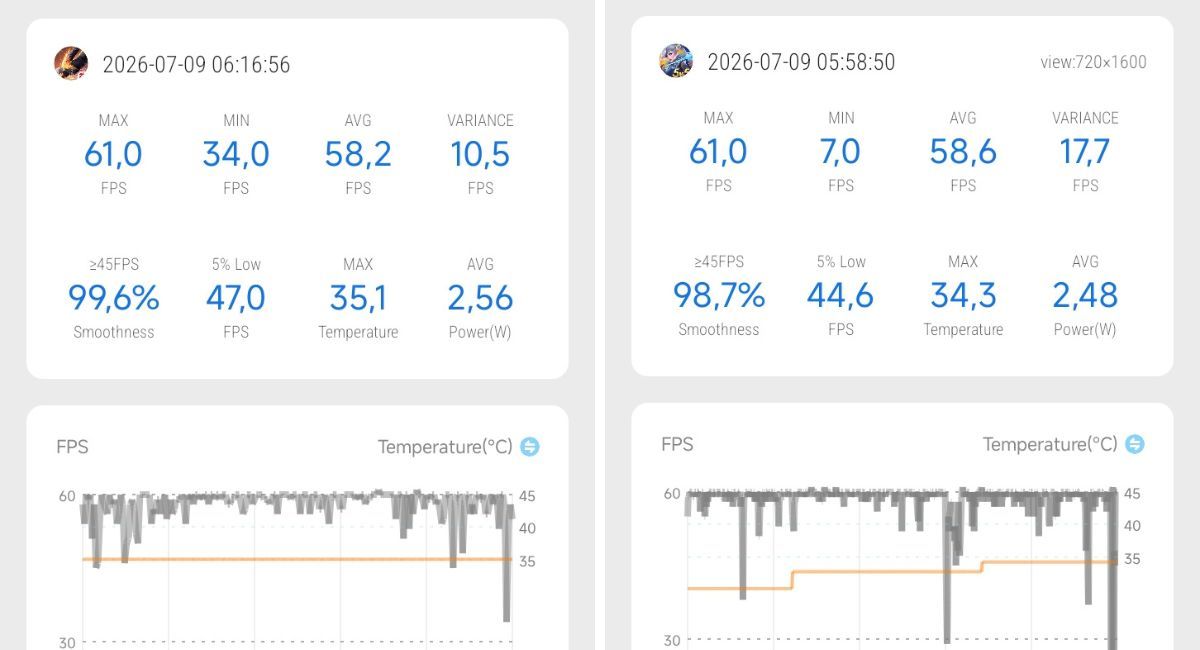
As for gaming performance, we have tested the Poco C81 Pro through 2 games that are quite popular, namely Free Fire and Mobile Legends:
Free fire (smooth + high frame rate): average 58.2 fps (max 61, min 34), smoothness 99.6%, 5% low 47 fps, temperature 35.1°C, consumption 2.56W.
Mobile Legends (High Setting, HD): Average 58.6 fps (max 61, min 7), smoothness 98.7%, 5% low 44.6 fps, temperature 34.3°C, consumption 2.48W.
For light games such as Free Fire and Mobile Legends, the performance is still relatively good with an average of close to 60 fps. Free Fire feels more stable, while Mobile Legends is still smooth but occasionally drops when the moment is crowded. The temperature of the device is maintained, indicating the efficiency of the chipset is quite good. However, 4 GB of RAM is again the main limit. If many apps run in the background, game performance may decrease.
In conclusion, the Poco C81 Pro is still worthy of light gaming, but not for heavy games or competitive gaming sessions.
Battery
The battery is the main advantage of the Poco C81 Pro with a capacity of 6,000 mAh. In PCMark Work 2.0 testing, the device can last up to 22 hours, an excellent number for the HP class of IDR 1 million and shows solid power efficiency for day or even more use in real scenarios. In daily use, this device can generally last a full day, even up to two days for light users. This makes it suitable for students, field workers, or users who don’t want to charge frequently.
The compromise is on the charging which is only 15W. With a built-in charger, in 30 minutes the battery is only charged from about 9% to 29%. For full charging up to 100%, the time required can reach about 2 hours 23 minutes, so it feels long enough for a battery capacity of this size.
Camera
The Poco C81 Pro carries a 13 MP main camera with support for AI-based features. On the front, there is an 8 MP camera. The rear and front cameras can record video up to 1080p 30 fps. For the entry-level price class, the results of the Poco C81 Pro camera should be assessed realistically. From the various samples tested, the camera character is quite consistent, where the main camera is able to produce interesting photos when the light is abundant, but begins to show limitations when facing high contrast, objects with intricate details, or uneven lighting.
In general, image processing on this device tends to increase sharpness and saturation so that the photo looks more “live” when viewed directly from the HP screen. This approach is indeed suitable for documentation and social media needs, but the consequences are fine details, dynamic range, and color accuracy are not yet a major force.
In bright light conditions, the main camera is still reliable. Details of objects such as plants, roads, or buildings are still quite clear, especially in the middle area of the frame. However, HDR capabilities are limited. Areas exposed to strong light often lose details, while shadowy parts can look too dark. Colors also tend to be made brighter, especially in green which sometimes looks a bit yellowish.
When used in more challenging light conditions, such as in the afternoon or cloudy, the quality begins to decline. Details in the distance look softer, and the camera seems to rely on noise reduction which is quite aggressive. The result does look clean at first glance, but fine details are also reduced. For close-up shooting, the camera is still quite good at locking focus and separating objects from the background naturally. However, highlights are still easily overexposed if the light is too hard.
The 8 MP front camera is enough for video calls, online classes, light meetings, and simple selfies. Facial exposure is generally well maintained, especially outdoors. However, facial details tend to be smoothed and a slightly warm skin tone. In low light conditions, the quality will quickly decline. Portrait mode is available and is able to provide a strong enough bokeh effect. The separation between the subject and the background is already visible, but the edge detection has not been consistent, especially on objects with intricate details such as hair, leaves, or twigs.
For videos, a 30 fps 1080p resolution is enough for basic documentation. However, this device is not an ideal option for content creators that require good stabilization, extensive dynamic range, or consistent audio-video quality. Overall, the Poco C81 Pro camera is still feasible for daily needs such as documentation, photos of goods, or casual uploads to social media. However, the camera is not the main selling point of this device.
Additional features and software
The software sector is an interesting part of the POCO C81 Pro. This device runs HyperOS 3 and brings a number of features that make the usage experience more modern. Additional material also mentions the integration of Google Gemini, including Gemini Overlay, Gemini Live, Image Generation, and Circle to Search. What is more interesting is the promise of system updates. Additional material says the Poco C81 Pro is guaranteed to upgrade Android up to four times. For a cellphone of Rp. 1 million, this claim is very strong because entry-level devices usually do not get software support that long.
Other features that remain important are the fingerprint sensor on the side, a 3.5 mm audio jack, microSD slot, USB-C, dual-band Wi-Fi, Bluetooth 5.2, and NFC support depending on region. The presence of audio jacks and microSD is clearly still relevant for entry-level users who want to use cable earphones or increase storage without having to buy a larger internal variant.
Advantages of Poco C81 Pro
- 6.9 inch large screen convenient for entertainment and reading
- Refresh rate 120Hz makes scrolling smoother
- 6,000 mAh battery is very durable for daily use
- UFS 2.2 storage provides more responsive performance in its class
- Support Android updates up to four times for long-term use
lack of poco c81 pro
- Screen resolution is still HD +, not Full HD +
- Unisoc T7250 chipset is less suitable for heavy gaming
- Limited 4 GB physical RAM for multitasking
- The camera is only enough for basic documentation
- 15W Charging Feels Slow For Big Battery
- still using 4G network, not support 5G
Conclusion: worth buying, as long as the expectations are right
The Poco C81 Pro is an entry-level smartphone that offers a combination of features that are quite interesting for everyday use, although it still comes with a number of distinctive compromises in the price class. This device is suitable for users who prioritize large screens, long battery life, and a fairly smooth usage experience for basic activities such as communication, social media, and light entertainment.
In the Rp 1 million segment, the main selling value lies in the 120Hz screen which makes the navigation feel smoother, as well as a 6,000 mAh battery that can support daily use or even more. Long software support is also a plus, because it provides a sense of security for users who want to use the device for a longer period of time without being quickly left behind from the system side.
However, it is important to understand the limits. The camera is only enough for simple documentation, the performance is not ideal for heavy gaming or intensive multitasking, and the screen quality is still limited to HD + resolution. In addition, features such as high fast charging and 5G connectivity are also not available on this device.
Overall, the Poco C81 Pro is a rational choice for students, casual users, or parents who need affordable HP with a focus on durability and basic convenience. For users with a higher need in the camera sector, performance, or other premium features, considering options in a higher price class will provide a more balanced experience.


