
smart way to improve the performance of an automatic motorbike without wasting gasoline

Optimizing the performance of the automatic motor without sacrificing fuel efficiency
Given that the pull of a light and responsive automatic motor is often considered to have to sacrifice fuel efficiency, many vehicle owners are stuck in the myth that performance improvement can only be achieved through extreme engine modifications or replacement of racing components that waste gasoline. However, the main key to the character of the automatic motor is actually in the transmission sector or Continuously Variable Transmission (CVT). If set properly, CVT can actually increase driving efficiency.
The CVT sector is the driving heart that transmits power from the engine to the rear wheels through a pulley and belt system. By optimizing certain components, engine power that was originally wasted due to skid or mechanical resistance can be channeled to the maximum. This article will dissect the technical steps in the transmission sector that are able to make the motor more powerful but still pocket-friendly for daily use.
1. Roller weight adjustment and precision CVT usage
The most powerful step to change the initial pull character of an automatic motor is to lose the roller weight by 1 to 2 grams from the manufacturer’s standard size. This weight loss that is not too extreme aims to make the front pulley open at low engine speed so that the acceleration feels lighter when starting the journey. In addition to changing the roller, the roller path in the pulley must also be ensured to be clean from dust and the remaining lubricant that hardens so that the movement of the roller remains smooth without obstacles.
To perfect the lower lap, replacement per CVT (Driven pulley) with a slightly harder size is highly recommended. If the standard motor uses per 1,000 rpm, replacing it with a size of 1,200 rpm will provide stronger compressive power on the V-belt belt. This stronger pressure ensures the v-belt clamping the pulley more quickly and minimize the occurrence of slippage when the engine gets a torque load. As a result, the motor does not need to “scream” at high rpm just to start driving, so that gasoline consumption is maintained.
2. Double Bowl Cartel Technique to remove clutch slippage
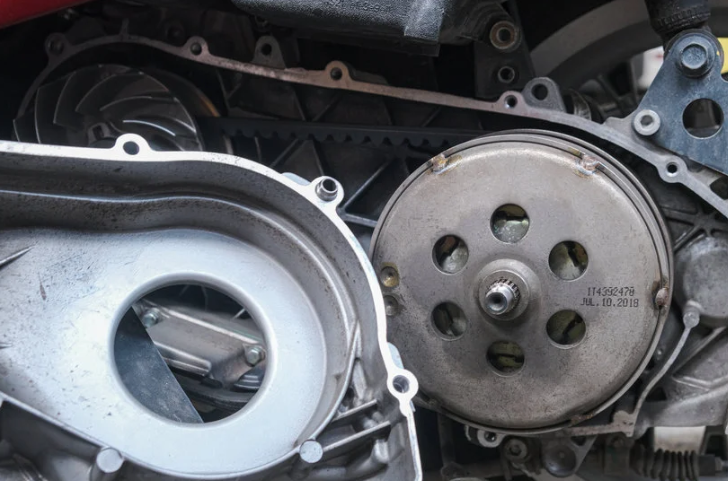
The main problem that often makes the automatic motor feel sluggish and wasteful is the power that is wasted due to the double canvas slipping on the clutch bowl. The “cartel” technique or giving a coarse texture and small holes on the inside of the double bowl becomes a very effective mechanical solution. The rough texture helps to increase the grip Grip Double lining, so that the power from the engine is directly channeled to the rear wheels without any wasted friction pauses.
with a cartel double bowl, vibration symptoms or GREDEK At the initial pull will be lost because the double lining bites faster and more consistently. In addition to increasing responsiveness, the holes in the bowl also function as a dust disposal route from the friction of the lining, so that the clutch area remains clean. The increased efficiency at this point automatically makes the machine work lighter because there is no wasted kinetic energy to heat due to excessive slippage.
3. V-belt maintenance and synthetic axle oil optimization
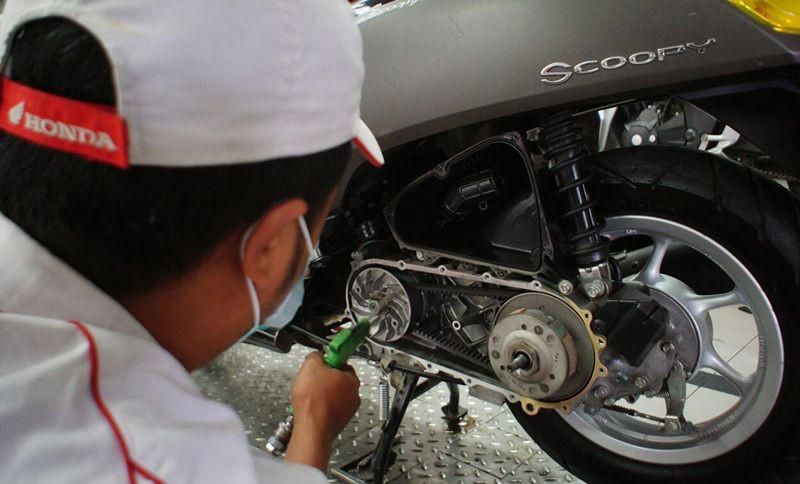


Maximum performance is impossible to achieve if the v-belt belt is in bad condition, such as cracked, hardened, or began to be delayed. Belts that are already inelastic will cause power transfer to be inefficient and risk breaking when driven at high speeds. Routine checking on the physical condition of the V-belt is an obligation so that every engine rotation can be converted into wheel motion accurately. A healthy V-belt ensures smooth speed displacement ratio without any significant mechanical resistance.
Finally, the aspect that is often forgotten is the regular change of axle oil. The gear ratio on the rear wheels requires good lubrication to reduce swivel resistance. The use of synthetic axle oil with a more diluted viscosity level can significantly reduce the friction between gears. With a smaller swivel resistance in the rear wheel area, the engine does not need to work extra hard to push the vehicle to drive, which ultimately has a positive impact on fuel economy in the long run.
Conclusion
By optimizing the transmission sector through roller adjustment, cartel technique in dual bowls, as well as v-belt and axle oil maintenance, automatic motorcycle users can feel a significant increase in performance without compromising fuel efficiency. This proves that the balance between strength and fuel economy is not a myth, but it can be achieved through proper care and modification.


